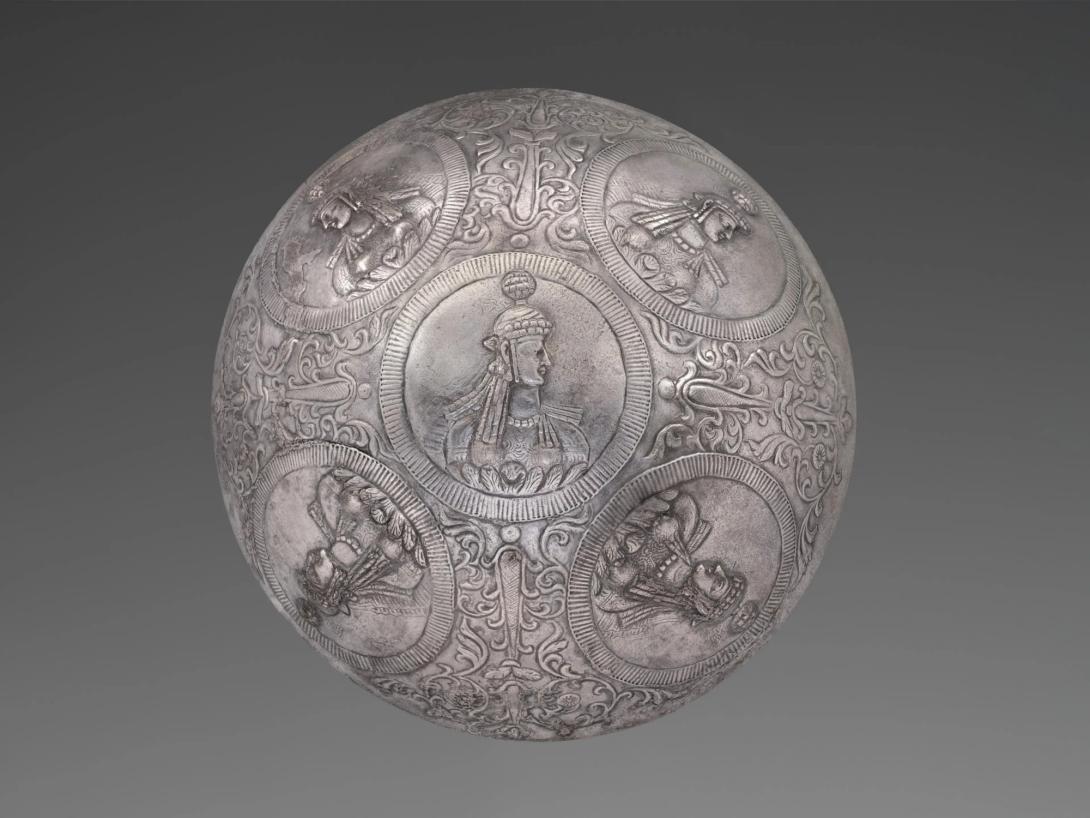
This Sasanian silver bowl, decorated with female figures, is a remarkable example of the sophisticated and distinctive metalworking tradition of the Sasanian period. It illustrates the prominent status of women during this era, particularly within the royal court and the upper social classes. Artworks such as this bowl frequently portray women in distinguished social and political roles, reflecting the respect and recognition they enjoyed in Sasanian society. The female imagery on these objects often symbolizes women's influence in the social, economic, and cultural life of the empire.
itsfh8 © ALL RIGHTS RESERVED🔻
 |
|
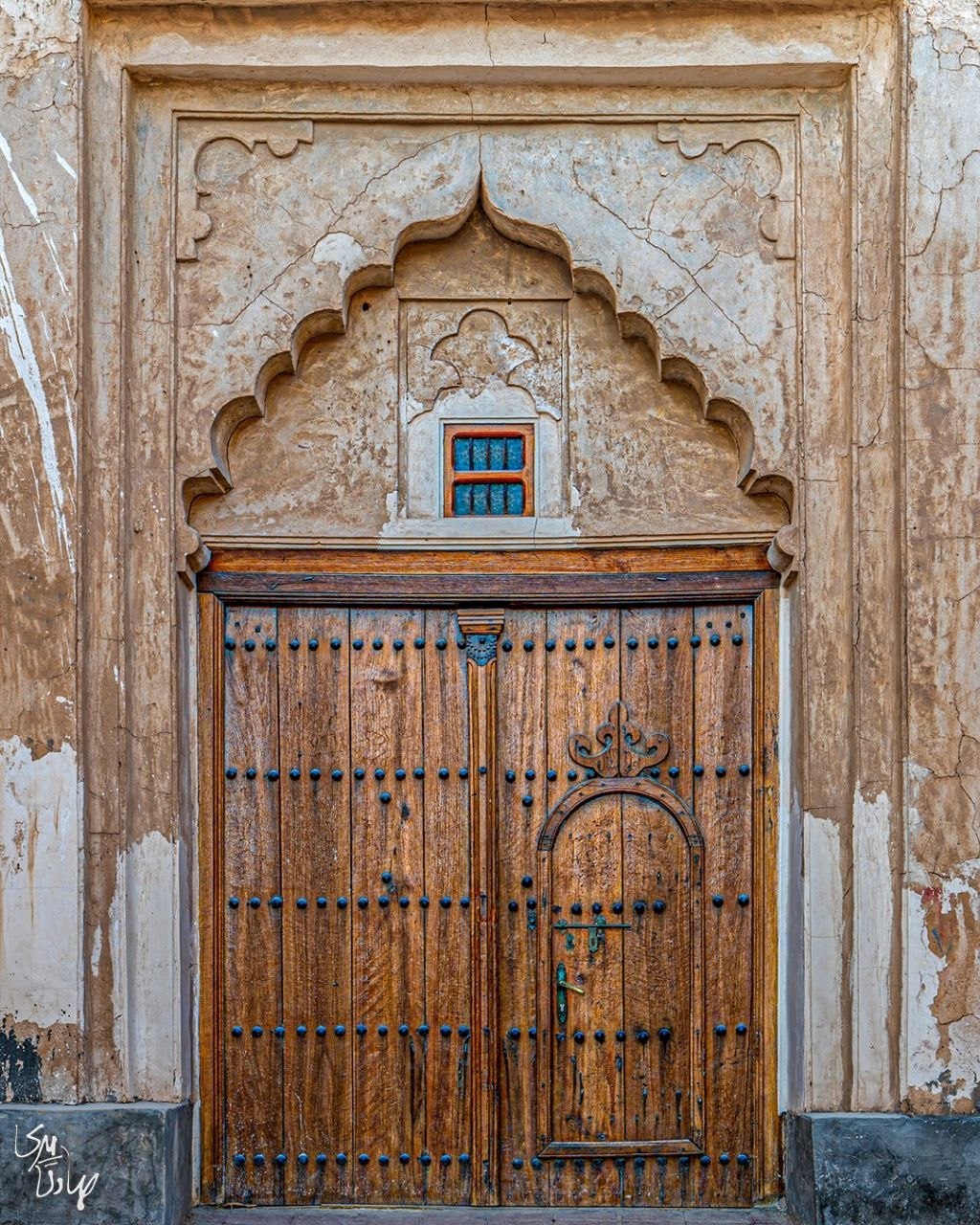
#بندر_کنگ #هرمزگان
Learn About Marriage in Iran
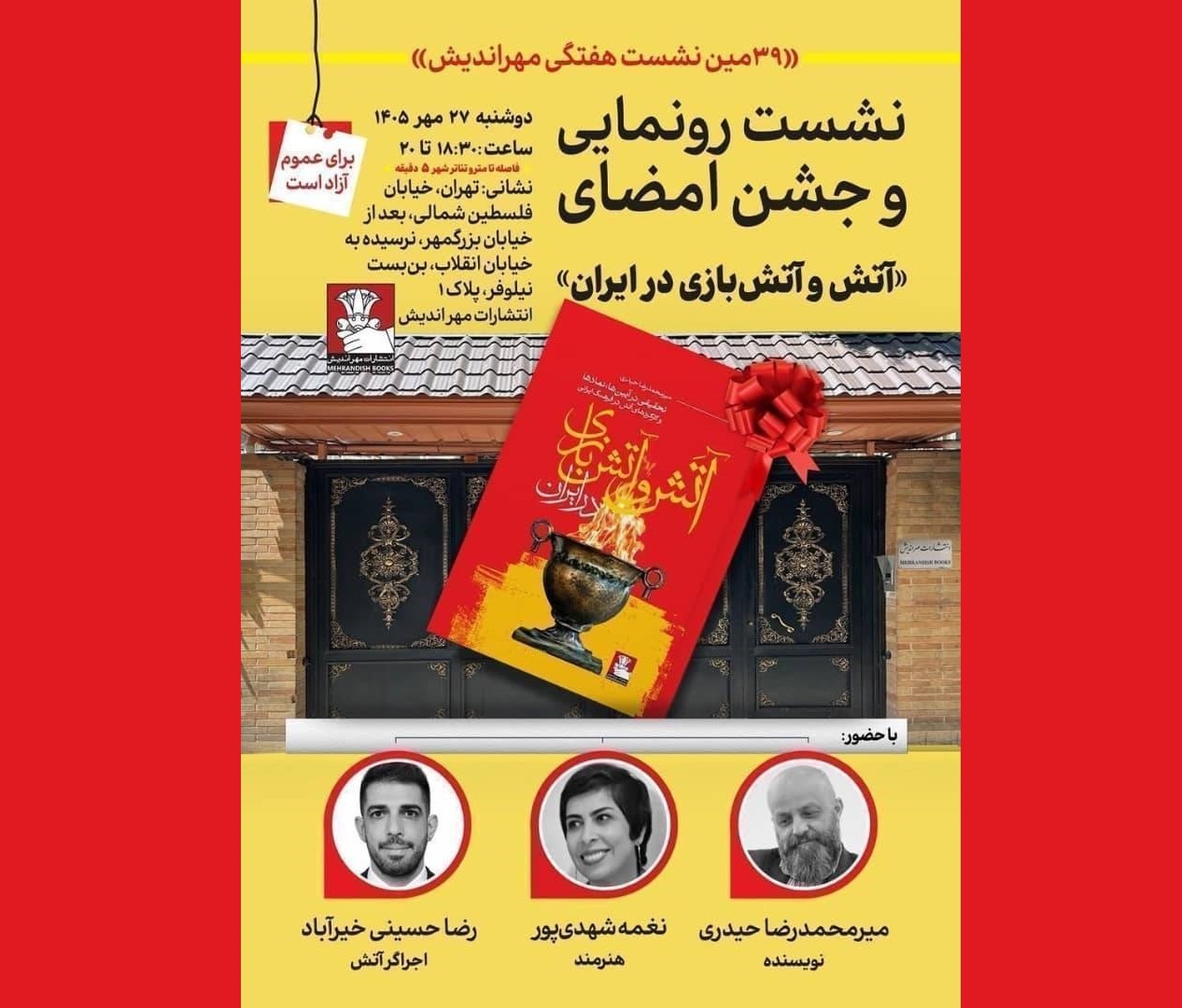
The book Fire and Fireworks in Iran is a study of the rituals, symbols, and functions of fire within Persian culture. It examines the significance of fire in ancient beliefs and rituals, as well as the evolution of its role throughout various historical periods. Beyond its ritualistic and symbolic dimensions, this work also explores fire in terms of its performative applications and its presence in both popular and royal festivities and forms of entertainment.
 |
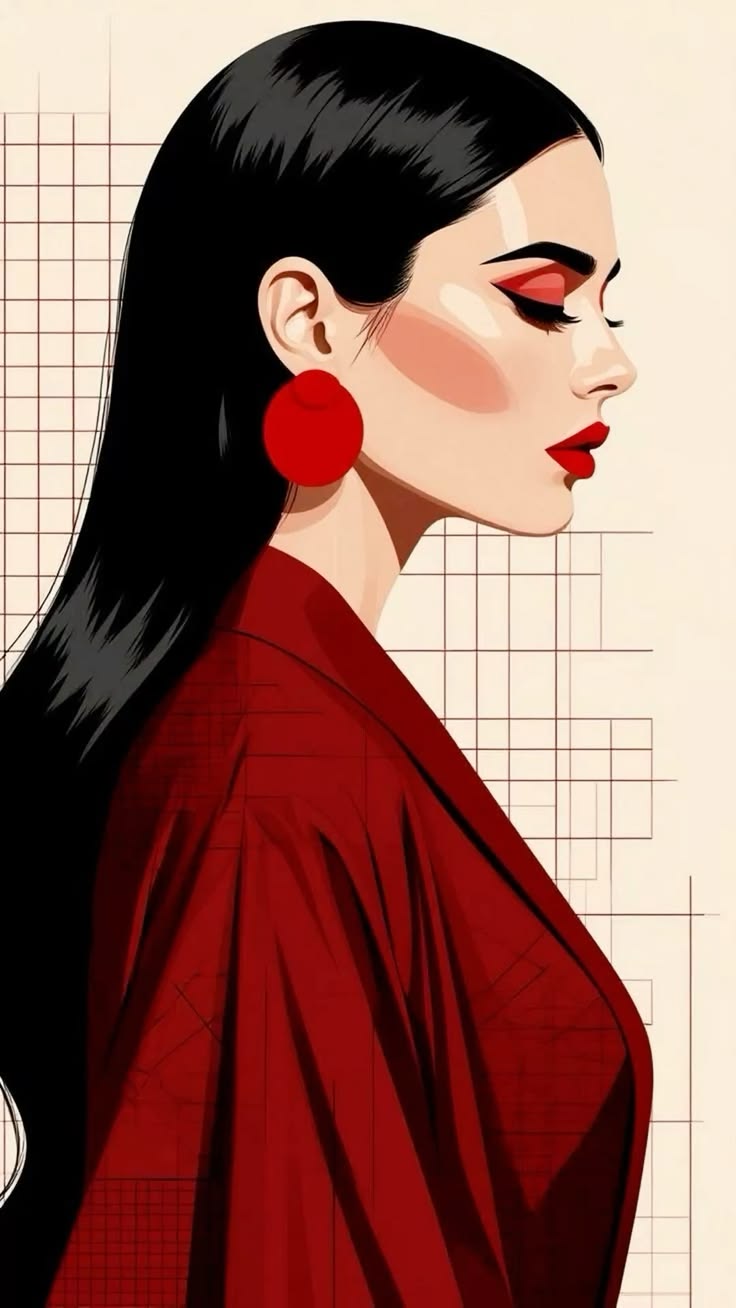 |
During the Sasanian period, women—especially those belonging to the royal court and the aristocracy—played significant roles beyond their familial responsibilities. They were active participants in political affairs and cultural life. Bowls such as this, depicting women in prominent settings, emphasize that women were not only held in high social esteem but also contributed to decision-making processes and cultural activities. As a result, these artistic works are regarded as enduring symbols of the power, prestige, and social influence of women in the Sasanian Empire.

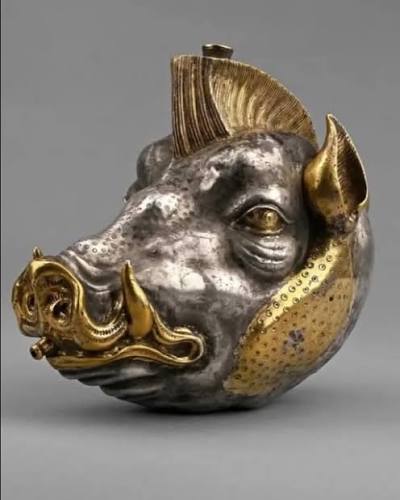
Sasanian Wild Boar Rhyton
A magnificent rhyton (drinking vessel) from the Sasanian era in Persia, crafted from a combination of gold and silver in the form of a Wild Boar Rhyton.
In Persian mythology, the Wild Boar is most closely linked to Verethraghna—a deity later known as Bahram (God of War & Victory) in Middle and New Persian. Verethraghna is the god of victory, martial prowess, and the triumph over chaos; he represents that raw energy which bursts from its lair whenever the cosmic order is threatened.
In the Avesta, Verethraghna can manifest in various forms, one of which is the male Wild Boar. This choice is no coincidence. In the Persian imagination, the Wild Boar is a tenacious, fearless, and terrifyingly unstoppable creature. Once it decides to charge, it neither calculates the path nor knows how to retreat. It embodies the very qualities expected of a victory deity: relentless pressure, the shattering of obstacles, and the breaching of barriers. As the ritual beverage pours from the Wild Boar’s mouth, power transforms into ritual, and ritual generates legitimacy.
But how was this rhyton created? The core of the object was most likely produced using the lost-wax casting method. In this process, the full form of the Wild Boar—complete with skin folds, snout, tusks, and even the expression of its gaze—was first sculpted in wax. It was then encased in a layer of refractory clay. When the mold was heated, the wax melted and drained away, leaving a hollow cavity that perfectly mirrored the original sculpture. Molten metal—usually silver—was then poured into the mold. Yet, there is a subtle nuance here: this was not merely a simple casting process. The real work began after the piece was removed from the mold. Gold details—such as the snout, tusks, mane, and parts of the face—were added using gilding or gold-overlay techniques.
During the Sasanian era, a common method was mercury gilding (amalgam gilding); gold was mixed with mercury and applied to the silver surface. Upon heating, the mercury evaporated, leaving behind a layer of gold—a hazardous yet highly precise process. Finally, the piece underwent chasing and finishing. The skin surface was textured with stippling to evoke the Wild Boar's coarse hide, eye lines and facial folds were defined using sharp steel tools, and the entire object was polished to create a stunning contrast between the cool silver and the warm gold.
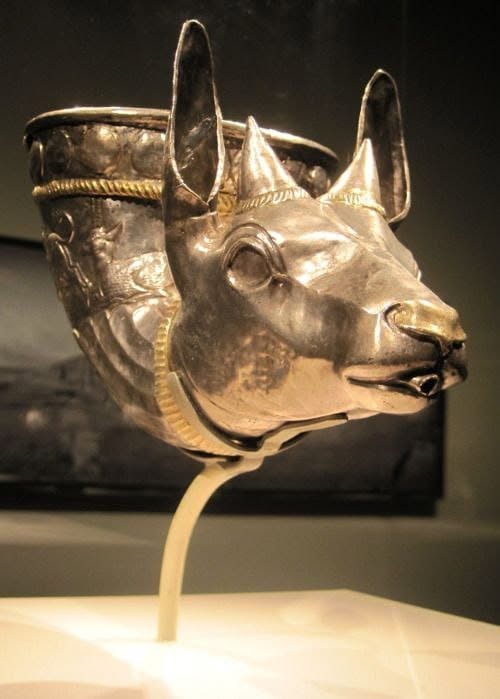 Sasanian Gazelle Rhyton |
 |
Such artifacts are more than mere metal vessels; they are symbolic expressions of the nexus between the hunt, ritual, and sovereignty. They remind us that to master the external world, civilizations must first conquer the realm of meaning. This piece was purchased from a New York gallery in the 1970s and has since been held in a private collection in London.
This is Naqsh-e Rustam—the resting place of the Great King Xerxes, carved into the cliffs of Pars; a testament to a civilization that must be understood not only through battlefields but also through its art, architecture, and enduring legacy. A man whose army marched on Athens to liberate the Greek people of Sardis and avenge them against the oppression of their warlike, tyrannical rulers.
Xerxes' Canal (Greek: Διώρυγα του Ξέρξη) is a historic, navigable canal located at the foot of Mount Athos on the Chalkidiki Peninsula in northern Greece. This massive structure was constructed by the order of the Persian King of Kings, Xerxes, in the 5th century BC; today, it is considered one of the few valuable remnants of the Persian Empire in the lands of the West.

The Burning of Athens by the Persians:
A Re-examination of the Historical Narrative
Following remarks by Mark Rubio, the United States Secretary of State and National Security Adviser, concerning the massacre and burning of Athens by the Persians, a group of experts and historians rose to respond to him. While accepting the same Greek premise that Xerxes had destroyed and burned Athens, they regarded it as a justified act of retaliation for the Greek burning of Sardis.
This pursuit of justice itself raises the question of a certain allegiance to one-sided perspectives and the established authority of Western historical narratives, which inevitably form part of the “war of narratives.” Here, once again, let us put the narratives that underpin this conception to the test of historical inquiry and subject them to critical scrutiny.
Historical quotations
“The killers and destroyers of Greece were not Xerxes and Mardonius, but those who instigated the Peloponnesian War—the internal wars of Greece itself.”
— Pausanias, historian and geographer
“In short, we displayed more courage than anyone else, a courage bordering on recklessness: no one on earth was coming to our aid … Nevertheless, we resolved to abandon our city and destroy our possessions … They even removed the wooden frameworks of their own houses.”
— Thucydides, History of the Peloponnesian War, speaking through an Athenian
The many destructions of Athens
Let the tour guide who, near the burial mounds of Marathon, proudly recites a summary of Aeschylus’s play The Persians speak for a moment. You will then see that what troubles all these accounts is the notion that the Persian brought everything to ruin: first the Persian, then the Persian again, and later the Turk.
Apparently, no one any longer wishes to remember the wars among the Greeks themselves, the Peloponnesian War and its consequences; the wars and devastation brought about by Philip, Alexander, and their ill-fated successors; or the Roman conquests and the plundering of Athens by Sulla. Nor does anyone wish to recall the Gothic invasions, during which Athens was so thoroughly plundered that, after the Goths had passed through, the Agora—the sacred marketplace of Athens—lay in ruins for more than a century.
Likewise forgotten are the damage inflicted on Athens before its occupation by the Turks and the systematic looting carried out by the Venetians under Francesco Morosini. After bombarding the Parthenon—the ancient sanctuary on the Acropolis of Athens built under Pericles—they carried away whatever the Romans had left behind. And this was before Lord Elgin’s depredations, when he attacked the Parthenon with such determination and greed that he even sought to remove its stucco decorations.
In a land so trampled upon, violated, plundered, and wounded, how can one identify the Persian contribution to its history? How can one determine whether Persia was responsible for the misdeeds for which it is condemned?
This is especially important because Thucydides, arguably the most truthful historian of ancient Greece, does not attribute any clearly defined or prominent event in this conflict to the Persians. Although he was himself a Greek aristocrat, he records a Greek speaker saying:
“I do not listen to the Athenians’ lengthy speeches; they praise themselves at great length …”
The unfinished work known as The History of the Peloponnesian War recounts the internal conflict between the Greeks, particularly Sparta and Athens, which took place after the Greco-Persian Wars.
If the massacre and burning of Athens by the Persians had been an event of the magnitude later accounts suggest, and had occurred in a form extending beyond the pages of historians’ books, it is difficult to imagine that Thucydides would have omitted it from his account. Indeed, he explicitly states, concerning the events surrounding the capture of Athens that preceded the Peloponnesian War:
“With regard to the events that marked the earlier period of this war … I believe that they were of little importance, both militarily and in other respects.”
He explains that his conclusion rests on evidence gathered through an investigation extending back to the most distant periods of the past.
The Peloponnesian War and the destruction of Athens
It was precisely the Peloponnesian War (431–404 BCE)—the conflict among the Greeks themselves that followed their wars against the Persians—that set Athens on the path to ruin.
This was an exhausting and devastating war that engulfed the entire Greek world. Athens’ strategic mistakes, particularly its disastrous expedition to Sicily, combined with the outbreak of plague in the city, ultimately brought about its comprehensive defeat.
The Spartans demolished Athens’ Long Walls and replaced its democracy with a repressive, puppet regime known as the Thirty Tyrants.
Athens’ temples: built and destroyed long after the Persians
In fact, when the Persians captured Athens, there were few structures for Xerxes’ troops to destroy beyond those built during the rule of the Peisistratid dynasty. As the late Amir-Mahdi Badiʿ put it:
“The city occupied by the Persians was not yet the museum-city admired by Atticus, the Platonist philosopher.”
In other words, the Athens of Pericles had not yet come into existence when Xerxes invaded. The city whose ruins we see today began to take shape in the middle of the fifth century BCE, with the construction of the Parthenon. Its development continued into the second century BCE, when building work on the Olympieion, abandoned during the Classical period and never completed, resumed under Antiochus IV Epiphanes, the Seleucid king.
Badiʿ writes:
“Athens, whose artistic, literary, and philosophical achievements produced some of the most beautiful blossoms of human thought, truly flourished only after Salamis. The city occupied by Xerxes’ armies was not the museum-city that delighted Atticus, Cicero’s friend, even after the plundering it suffered at the hands of Roman legionaries.
“Before Peisistratus, Athens was merely one among the many cities of Hellas. It was this tyrant and his son Hippias who gave it its impetus and laid the foundations for the progress that, over the course of a century, would transform it into the brain and soul, heart and capital of Hellenism.
“They were responsible for giving Athens several monumental buildings, an aqueduct, the nine-fountain structure, and the hundred-foot temple known as the Hecatompedon, thereby transforming it into a genuine city.
“Naturally, before the tyranny of the Peisistratid dynasty, Athens already possessed religious buildings. Yet these were so small and insignificant that today no one knows their locations or purposes.”
Years after the Persians’ capture of Athens in 480–479 BCE, new structures were erected in the Agora toward the end of the fifth century BCE. These included the Stoa of Zeus, a new Bouleuterion (council chamber), the Temple of the Mother of the Gods (the Metroon), and the precincts associated with the heroes of the Eponymous Heroes monument and other civic institutions. Further buildings followed.
As for the structures on the Acropolis:
-
The Parthenon, dedicated to Athena, was built between 447 and 438 BCE.
-
The Propylaea, the monumental gateway, was constructed between 437 and 432 BCE.
-
The Temple of Athena Nike dates to approximately 450 BCE, although a date of 428 BCE has also been proposed.
-
The Erechtheion, the sanctuary associated with Erechtheus, was built between 435 and 407 BCE.
Pericles’ Odeon was also contemporary with the Parthenon. The Temple of Zeus at Olympia was constructed between 470 and 456 BCE, while the Temple of Apollo at Bassae dates to the late fifth century BCE. The Temple of Poseidon at Sounion was built around 440 BCE, among other examples.
In 437 BCE, the Greek architect Mnesicles began construction of the Propylaea, a marble-columned monumental gateway, part of which was built over an earlier structure dating to the Peisistratid period. The building was completed around 432 BCE and consisted of two wings. The northern wing housed a picture gallery, while the southern wing incorporated a colonnaded sanctuary associated with Athena Nike.
Construction work continued after the Peloponnesian War and was completed during the Peace of Nicias (421–415 BCE). It was also during this period that work began on the Erechtheion, a complex encompassing sanctuaries associated with Athena Polias, Poseidon, Erechtheus, Cecrops, Ares, Pandrosus, and other figures. Between the Temple of Athena Nike and the Parthenon stood the sanctuary of the Brauroneion.
Thus, according to the article’s argument, none of the buildings whose ruins now lend distinction to the Acropolis was subjected to the Persian destruction commonly attributed to Xerxes. Even its massive walls—the foundations that support the site and contribute to its distinctive grandeur—were not attacked by the Persians, since these walls, too, were built in the fifth century BCE, after the Persian withdrawal.
How were these monuments destroyed?
Although Athens had been part of the Roman Republic since 146 BCE, it supported the king of Pontus, Mithridates VI, during the Mithridatic Wars of the first century BCE—nearly half a millennium after the Persian campaigns.
In 86 BCE, the Roman general Sulla attacked and plundered the city. The resulting Roman siege of the Acropolis caused the destruction of, or damage to, several sanctuaries. Pericles’ Odeon was burned, and the Asclepieion suffered extensive damage. Sulla also ordered several columns from the Temple of Zeus to be transported to Rome.
But do you know who undertook to compensate for these losses? Surprisingly, it was a generous “true barbarian”—that is, a Persian—named Ariobarzanes II, King of Cappadocia, a descendant of the famous satrap of Pontus during the reign of Artaxerxes II Mnemon. He generously sponsored the reconstruction of Pericles’ Odeon. Two Greek inscriptions attest to this contribution.
Pausanias, the second-century CE geographer, described the newly reconstructed building as “the most magnificent of all the Greeks’ buildings.” He also recorded the tradition that the structure, rebuilt in the first century BCE, was modelled on Xerxes’ tent.
In the course of this architectural development, the form of Greek temple architecture was transformed, and a distinctive feature of Iranian architecture—the arch—was introduced into it.
Athens under Ottoman rule and the Venetian bombardment
In 1458, Athens fell to the Ottoman Empire and remained part of it for nearly four centuries. During this period, the Parthenon was converted into a mosque, while some buildings on the Acropolis were transformed into structures resembling Florentine palaces and Turkish harems. The city had little distinction and had become a small settlement.
Yet a tremendous explosion at seven o’clock on the evening of Friday, 26 September 1687, destroyed a substantial part of the Parthenon, by then approximately two thousand years old, and altered the course of one of the world’s most important historical monuments.
The Parthenon on the Acropolis suffered a devastating blow when part of it was destroyed during the Venetian assault on Ottoman-held Athens under Francesco Morosini, commander of the Venetian forces.
Although the Propylaea had already suffered damage, the Ottoman forces had fortified the Acropolis and were using the Parthenon as a gunpowder magazine. They presumably believed that Morosini would respect the historic monument and refrain from attacking it.
However, a Venetian mortar shell fired from Philopappos Hill struck the magazine. The resulting explosion demolished the central section of the building and brought down the walls of its inner chamber. Many columns collapsed, while architectural elements, including capitals and decorative features, fell to the ground.
Approximately 300 people were killed in the explosion, and fragments of marble were scattered across the surrounding area. Fires also broke out, destroying many nearby houses.
Morosini subsequently took advantage of the situation to plunder the surviving sculptures, causing further damage. The statues of Poseidon and Athena’s horses fell and broke when attempts were made to remove them from the western façade.
In 1688, the Venetians withdrew from Athens to avoid a confrontation with the larger Ottoman forces assembled at Chalcis. At the time, it was even proposed that the remains of the Parthenon and the entire Acropolis be blown up to prevent their use as military fortifications. Fortunately, this proposal was not carried out.
Many of the sculptures that survived from the temple were subsequently taken to England by Lord Elgin, the British ambassador to the Ottoman court. They are now held in the British Museum.
After the Greek War of Independence, Athens was selected in 1834 as the capital of the newly established Greek state. The decision was motivated more by historical and symbolic considerations than by practical ones.
European architects, particularly Bavarians, were commissioned to create a modern capital inspired by the ideals of Neoclassicism. In the process, many surviving Ottoman and Byzantine structures were demolished in the name of “restoring ancient grandeur,” in order to present an idealised and sanitised image of the city’s Classical past.
In 1880, large quantities of highly valuable Acropolis marble were also transferred to the London museum without Greece’s consent. Some of these artefacts subsequently suffered erosion and deterioration due to air pollution.
Examining how the Persians treated Athens
Beyond the question of how a Persian ruler, himself shaped by Iranian teachings on kingship, could have pursued vengeance and retaliation in the manner of the gods in Greek stories, one must also remember that burning territories and polluting fire during warfare evoke the world depicted by the “Father of History,” Herodotus, and those who followed in his footsteps, rather than the Iranian worldview—particularly Zoroastrianism.
The image of Xerxes presented in such accounts is reminiscent of the portrayal popularised by the film 300.
Even Herodotus cannot conceal the entire story. He writes:
“On the following day, Xerxes summoned the Athenians who had been driven from Athens—the Peisistratids—who were accompanying his army, and ordered them to ascend the Acropolis and offer sacrifices and perform rites according to the customs of their own religion and country … The Athenian exiles carried out his orders.”
Setting aside the striking contrast between this account and the conduct commonly attributed to Xerxes after the Persian destruction of Athens, a question arises: if the sanctuary had indeed been destroyed on his orders and its olive tree burned, as the Greeks claimed, how could the Athenians have performed their religious rites and offered sacrifices there according to the customs of their own land?
A different interpretation of the Persian capture of Athens
A number of scholars, including the British professor Andrew Robert Burn, put forward detailed and bold interpretations of the alleged plundering of Athens. Burn first presented his views in 1962.
He argued that the Persian king destroyed the fortress of the Acropolis, not the sanctuaries on the Acropolis. According to this interpretation, Xerxes ordered the destruction of the Acropolis fortress, a military stronghold, while the city walls surrounding Athens were not destroyed. The fortress stood on the Acropolis hill and had been built by Peisistratus.
Athens itself was undefended: its inhabitants had evacuated it, and no battle had been fought to defend the city. In the military conventions of the time, undefended cities were not necessarily destroyed.
This approach to interpreting the classical Greek accounts, particularly those of Thucydides, is important for reassessing Xerxes’ campaign. It represents one of the historical revisions emphasised by Professor Burn and several other scholars.
Two principal points underpin this interpretation:
1. Distinguishing the military fortress from the temples and the city. Burn argues that Xerxes’ objective was not to destroy the whole city of Athens, but to demolish the Acropolis fortress, which served as a military base and stronghold of resistance. The fall of the Acropolis should therefore not be equated with the total destruction of Athens or the identical fate of every part of the city. According to the military conventions of the period, Athens, having been evacuated and offering no urban resistance, could be regarded as an undefended city that did not require complete destruction.
2. The resumption of everyday life and the absence of a general massacre. Burn’s account of the Athenians’ return to the city, the provision of temporary shelter, and the resumption of agricultural activities and the planting of autumn crops suggests that life began again after the occupation. This is significant when contrasted with portrayals that depict the city as having been completely annihilated and all human activity brought to an end.
Notes
1. Lucius Cornelius Sulla Felix (138–78 BCE). Known as Sulla, he was an authoritarian Roman general and politician of the Roman Republic. Plutarch wrote a biography of him.
2. Goths
3. Morosini. Francesco Morosini, the Venetian military commander involved in the assault on Ottoman-held Athens in 1687
4. Elgin. Lord Elgin, the British ambassador to the Ottoman court who removed sculptures from the Parthenon
5. See: “Who Is the Most Truthful Greek Historian?!” by Farshid Ebrahimi, Amordad Iranian Studies Magazine, issue 412, Khordad 1398 (May–June 2019)
6. Thucydides, The History of the Peloponnesian War, Book I, section 86. See the Persian translation by Mohammad Hassan Lotfi, 1377 (1998), p. 65
7. The History of the Peloponnesian War
8. Thucydides, The History of the Peloponnesian War, Book I, introduction, “The Importance of the Present War.” See the Persian translation, 1377 (1998), p. 25
9. The Thirty Tyrants. In Ancient Greek, hoi triákonta týrannoi (οἱ τριάκοντα τύραννοι). This was a Spartan-backed oligarchy and authoritarian regime imposed on Athens following the Athenian defeat in the Peloponnesian War in 404 BCE
10. Amir-Mahdi Badiʿ, Greeks and Barbarians, vol. 3, translated by Qasem Sanavi, pp. 216–217
11. Bouleuterion
12. Erechtheion
13. Odeon
14. Olympie
15. The Mithridatic Wars. The term refers to three wars fought during the first century BCE between the Roman Republic and the Kingdom of Pontus. They were named after Mithridates VI, the king of Pontus at the time.
16. The Odeon of Athens, or Odeon of Pericles. A venue for musical performances and musical competitions, covering approximately 4,000 square metres (43,000 square feet). It stood at the southeastern foot of the Acropolis, beside the entrance to the Theatre of Dionysus.
17. Vitruvius, The Ten Books on Architecture (De Architectura), Book V, Chapter 9, section 1; and the two Greek inscriptions IG II² 3427 and IG II² 3426, which mention Ariobarzanes and the three supervisors of the reconstruction. See also:
Thompson, Homer A., and John McK. Camp II. The Athenian Agora: A Guide to the Excavation and Museum. 4th ed. Athens: American School of Classical Studies at Athens, 1990
18. Pausanias, Description of Greece, Book I, section 20, paragraph 4
19. Herodotus, The Histories, Book VIII, section 54. See the Persian translation, 1389 (2010), p. 912
20. Burn, A. R. Persia and the Greeks: The Defence of the West, 546–478 B.C. 2nd ed. London: Duckworth, 1984
References
- Ebrahimi, Farshid. A Godfather for History: A Call for the Rewriting of Achaemenid History. Abrishami-Far, 1389 (2010–2011)
- Badiʿ, Amir-Mahdi. Greeks and Barbarians. 15 volumes, translated by a team of translators. Tous, 1387 (2008–2009)
- Pirnia (Moshir al-Dowleh), Hassan. Ancient Iran, vol. 1: The History of the Ancient East. Ibn Sina Publications, 1332 (1953–1954)
- Thucydides. The History of the Peloponnesian War. Translated by Mohammad Hassan Lotfi. Kharazmi, 1377 (1998)
- Khalili Safa, Saeedeh. “The Day the Parthenon Was Destroyed: The Explosion That Brought Down the Symbol of Athens.” Kajaro, Thursday, 17 Ordibehesht 1405 (7 May 2026)
- Durant, Will. The Story of Civilization, vol. 2: The Life of Greece. Translated by Amir-Hossein Aryanpour et al. Organization for the Publication and Dissemination of the Islamic Revolution, 1365 (1986–1987)
- Herodotus. The Histories of Herodotus, vol. 2. Translated by Morteza Saqebfar. Asatir, 1389 (2010–2011)
- Burn, A. R. Persia and the Greeks: The Defence of the West, 546–478 B.C. 2nd ed. London: Duckworth, 1984
- Thompson, Homer A., and John McK. Camp II. The Athenian Agora: A Guide to the Excavation and Museum. 4th ed. Athens: American School of Classical Studies at Athens, 1990
Page Term Reference
Comments